Description
Ordering Information_x000D_
_x000D_
_x000D_
_x000D_
| Best Value Full System Kit | _x000D_
Includes three wavelengths (UV + VI + RB) | _x000D_
_x000D_
_x000D_
| Single wavelength full systems | _x000D_
Available in non-UV or UV wavelengths | _x000D_
_x000D_
_x000D_
| Add-on single wavelengths | _x000D_
Available in non-UV or UV wavelengths | _x000D_
_x000D_
_x000D_
_x000D_
_x000D_
_x000D_
Fluorescence solutions _x000D_
_x000D_
The key elements of any fluorescence system are:_x000D_
– a
light source that produces sufficient energy in the appropriate wavelength range to excite fluorescence in the sample of interest;_x000D_
– a
barrier filter in the viewing path that blocks reflected excitation light while transmitting the fluorescence emitted by the sample._x000D_
_x000D_
NIGHTSEA implements these for the Hirox microscope with:_x000D_
– high intensity LED light sources available in five excitation wavelength ranges (see list further down page);_x000D_
– emission barrier filters that can be added to the Keyence lenses easily and non-invasively._x000D_
_x000D_
_x000D_
_x000D_
 | _x000D_
_x000D_
_x000D_
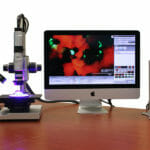
| Hirox microscope with NIGHTSEA fluorescence adapter | _x000D_
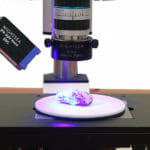
Detail of NIGHTSEA light head and barrier filter with Hirox microscope | _x000D_
_x000D_
_x000D_
_x000D_
_x000D_
_x000D_
Here is a sample of what you can see. For many more examples visit our
Hirox image gallery._x000D_
_x000D_
_x000D_
_x000D_
| _x000D_
| _x000D_
| _x000D_
| _x000D_
| _x000D_
_x000D_
_x000D_
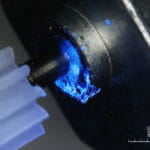
| Epoxy on motor shaft, 20x, UV excitation | _x000D_
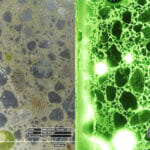
Concrete thin section, 20x, white light and fluorescence under Royal Blue excitation | _x000D_
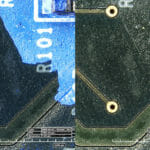
Conformal coating on circuit board, 20x, fluorescence under UV excitation and white light light | _x000D_
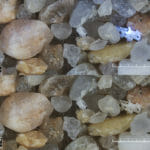
Bone in sand, 20x, fluorescence under UV excitation and white light | _x000D_
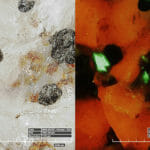
Fluorescent mineral, 20x, white light and fluorescence under Royal Blue excitation | _x000D_
_x000D_
_x000D_
_x000D_
_x000D_
_x000D_
Comprehensive solution kit_x000D_
We have configured a versatile Hirox fluorescence adapter kit (part number SFA-K-IND) that includes the most useful excitation wavelengths for varied industry applications. The SFA-H-IND kit includes the following items, at a package price that is significantly less than purchasing the items separately:_x000D_
_x000D_
– Three excitation light heads – Ultraviolet (UV), Violet (VI), and Royal Blue (RB) . This recommendation is based on our experience with varied applications. Read the explanation below._x000D_
– Three barrier filters paired to the excitation light heads_x000D_
– Matching barrier filter glasses for each excitation wavelength_x000D_
– Gooseneck lamp base with dimming control_x000D_
– Universal power supply – 120/240VAC, 50/60Hz, with international plug set_x000D_
– Packing/carrying case with custom-cut foam_x000D_
_x000D_
We do offer additional wavelength sets that may be of use for other applications._x000D_
_x000D_
Why we recommend a set of three excitation wavelengths for industry needs_x000D_
_x000D_
We have found that the combination of the Ultraviolet, Violet, and Royal Blue excitation/emission sets addresses a wide variety of industrial imaging challenges. The most common misconception we encounter is that fluorescence is uniquely associated with ultraviolet (UV) light and many customers immediately ask for that wavelength. However we have found in several cases – even some in which UV was specifically recommended by a dye manufacturer – that either Violet or Royal Blue provided superior performance. For example:_x000D_
_x000D_
– A prospective customer wanted to image concrete thin sections impregnated with fluorescent dye. The dye supplier recommended UV, and it is true that UV will make the dye fluoresce nicely. We found that our Royal Blue excitation produced significantly brighter fluorescence._x000D_
_x000D_
– Similar to above, except that a fluorescence epoxy had been used to highlight surface cracks in a test sample. Royal Blue excitation yielded brighter fluorescence._x000D_
_x000D_
– A prospective customer sent us a sample of material that was known to fluoresce under UV. The goal was to see the distribution of non-fluorescent particles in a fluorescent matrix. While both UV and Royal Blue excited fluorescence in the sample, the best imaging contrast was achieved with Violet excitation._x000D_
_x000D_
Acquiring the three-color system will provide the highest chance of success and will equip you with a versatile toolkit to address new fluorescence imaging challenges as they arise._x000D_
_x000D_
Wavelength sets_x000D_
_x000D_
There are five excitation/emission wavelength combinations available for the system._x000D_
_x000D_
_x000D_
_x000D_
| Color | _x000D_
Designation | _x000D_
Excitation | _x000D_
Emission | _x000D_
_x000D_
_x000D_
| Ultraviolet | _x000D_
UV | _x000D_
360 – 380nm | _x000D_
415nm longpass | _x000D_
_x000D_
_x000D_
| Violet | _x000D_
VI | _x000D_
400 – 415nm | _x000D_
450nm longpass | _x000D_
_x000D_
_x000D_
| Royal Blue | _x000D_
RB | _x000D_
440 – 460nm | _x000D_
500nm longpass | _x000D_
_x000D_
_x000D_
| Cyan | _x000D_
CY | _x000D_
490 – 515nm | _x000D_
550nm longpass | _x000D_
_x000D_
_x000D_
| Green | _x000D_
GR | _x000D_
510 – 540nm | _x000D_
600nm longpass | _x000D_
_x000D_
_x000D_
_x000D_